ROGER MCKENZIE on the importance of the Adelante Latin America conference to take place in January 2024
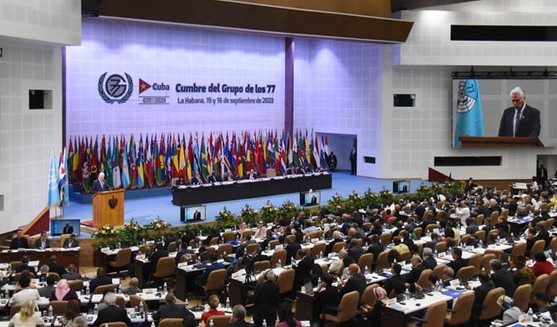
IN SEPTEMBER the leaders of 135 nations, representing more than 80 percent of the world’s population, condemned the US blockade against Cuba at the G77 Summit in Havana. The scant coverage that this received here is outrageous. A few days later those same countries travelled to New York to take part in the United Nations General Assembly, and again their demand to lift the six-decade-old brutal sanctions was ignored.
We must understand that the old colonial powers, led by the United States, continue to act in the same condescending way they have always done. To them, the Global South is irrelevant except to provide natural resources and cheap labour to make rich nations even more prosperous than they already are.
Western countries are happy to see the Global South take the hit from the climate emergency, largely caused by the carbon emissions of the rich. To them, nations of the Global South should not expect to be treated with respect and as equals. They are expected to follow the so-called “rules-based international order” set down by the US or risk unilateral sanctions – rules which the US itself, as the self-appointed “leader of the free world”, is free to ignore.
In his opening address to the G77 plus China meeting, Cuban President Miguel Díaz-Canel said it was now in their hands “to change the rules of the game.” Not only should national leaders take notice of this observation, but so should activists across the globe.
The choice we have is either to continue to do the same things whilst expecting different results, or to look at how the rules of the game can be changed to support progressive politics.
During his excellent speech to the UNGA, Brazilian president Luiz Inácio Lula da Silva highlighted the huge challenge facing Latin American countries and the rest of the Global South.
The Brazilian president pointed at the global increase in racism and xenophobia. Even the most progressive governments will do well to remember his words, and not to presume that this rise in racism exists everywhere but in their own nations.
Brazil is the country to which most enslaved Africans were forcibly shipped during the transatlantic trade of human beings. Many of the descendants of those enslaved Africans have long campaigned against the economic and social discrimination that they continue to face.
What Brazil has in Lula is a leader who recognises that this historical and deep-rooted racism must be tackled.
Lula also warned against the rise of “far-right adventurers” selling impossible solutions to the public. For examples of this we need look no further than Lula’s predecessor Jair Bolsonaro and to their neighbour Argentina, where the Trump-like far-right figure Javier Milei has placed himself in a strong position to win the country’s general election on 22 October. Even if Milei does not win the election, he looks set to continue to be a dominant figure in Argentinian politics. The struggles to put bread on the table and to keep a roof over their heads has sometimes tempted members of working class and peasant communities into supporting the easy solutions offered by these politicians, who present themselves as being against the system.
As Lula said in his UNGA address, many have “fallen to the temptation of replacing failed neoliberalism with primitive, authoritarian, and conservative nationalism.”
The election of the so-called “pink wave” across Latin America was partly a reaction to failed neoliberal policies in the region.
People are looking to break the power of the right-wing political elites and of those portraying themselves as progressive but who in reality, much like in Britain, only offer more of the same.
So when the left makes promises to the people, they need to be kept.
When Sandinista leader Daniel Ortega returned to power in 2006 he promised his country free education and health care – he delivered them within two years.
When I visited Nicaragua to join the 44th anniversary celebrations of the 1979 Revolution on 19 July, it was obvious how much the people of the country support Ortega and the Sandinistas.
Sadly there are still too many who believe a revolution is a bed of roses where the opposition conducts itself in a fair way, and will just shake hands and give up all the power and wealth they have accumulated over the years. These elites fight back, whether through legal means or through coups, financed and promoted by or from the US.
As the US tries to defend its financial, political, economic and military dominance of the world, we as activists need to remember that Latin America lives in the shadow of the US superpower.
Our job is to work out how we can best provide the solidarity and support they need, not just to survive, but to prosper and to act as a beacon for the left elsewhere.
That’s why the annual Adelante Latin America Conference is important. It gives us an opportunity to gather and listen to the always impressive list of speakers.
Adelante also gives us the chance to work out collectively how we can best organise our support and solidarity for a socialist Latin America and world.
Roger McKenzie is the international editor of the Morning Star and one of the speakers at Adelante Latin America Conference on 27 January. This article was published by CubaSi Autumn 2023.
 Latin America Adelante! Conference 2026