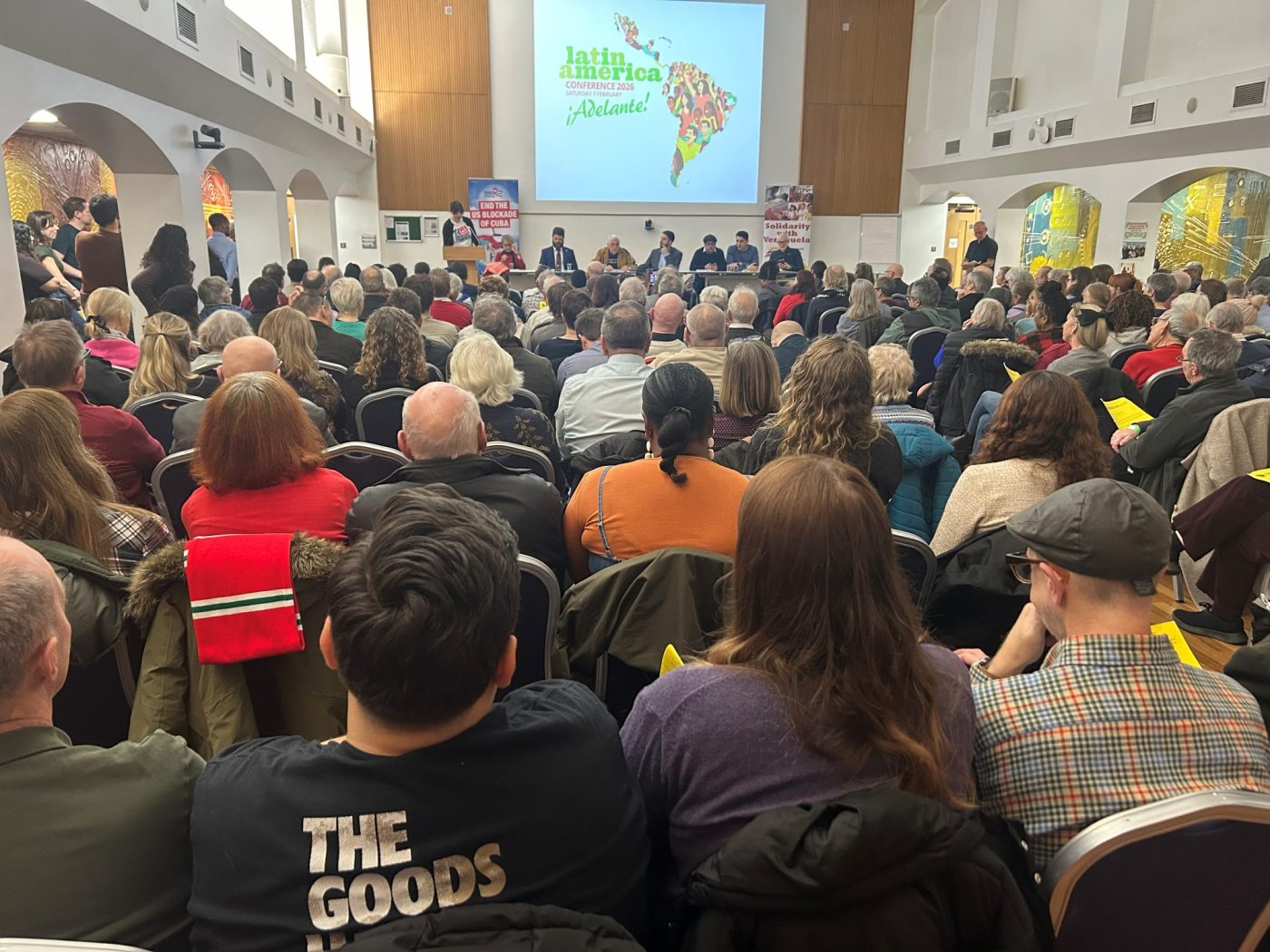
As US aggression intensifies, activists, trade unionists and politicians gathered in London to renew international solidarity with Cuba, Venezuela and progressive movements across Latin America.
At the Latin America Conference 2026, hosted at the National Education Union (NEU) headquarters in London, trade unionists, politicians, academics and activists gathered at a critical moment for the region. Across plenaries and panels, a clear theme emerged: escalating US aggression under Donald Trump’s second term means we need urgently to strengthen international solidarity with Cuba, Venezuela and progressive movements across Latin America.
Opening plenary
Opening the conference, Bernard Regan described a “particularly crucial moment” following recent US actions against Venezuela and new executive measures targeting Cuba. Kate Hudson placed these developments within a wider strategy of renewed US global dominance.
Sarah Kilpatrick of the NEU drew on her experience of the union’s 2024 delegation to Cuba, contrasting the island’s commitment to education as a social good with what she described as a growing climate of fear in the United States. She condemned US actions towards Cuba and Venezuela as “a clear breach of international law.”
International speakers brought first-hand perspectives. Wilfredo Hernández Maya of the Venezuelan Embassy stressed the urgency of defending peace and protecting political leaders under threat. Colombian human rights lawyer Diego Martínez warned that the gains made under Gustavo Petro remain vulnerable to destabilisation.
Jeremy Corbyn MP called for a foreign policy grounded in peace and international law, criticising the UK and EU for failing to challenge US actions and suggesting alignment with Washington has placed them “on the wrong side of virtually every issue facing this planet.”
One of the most anticipated contributions came from Fidel Antonio Castro Smirnov, who warned of the unprecedented pressure facing Cuba. “We see Donald Trump and Marco Rubio obsessed with destroying my country,” he said. Marking the centenary year of Fidel Castro’s birth, he recalled being taught by his grandfather that: “No force is stronger than people standing together.”
“So today, we do not ask for sympathy,” he told delegates. “We ask you to walk beside us. When they try to crush us with blockades, help us hold the line. When they try to silence us, please be our voice. When they try to isolate us, be the bridge.”
Closing plenary
The final plenary returned to the conference’s central political questions. Chris Hazzard argued that current developments reflect a “force-based international order,” drawing parallels with Ireland’s history. Labour NEC member Jess Barnard described US policy as the actions of “a dying empire lashing out,” calling for a stronger response from Britain.
Mariela Kohon outlined the TUC’s opposition to US targeting of Cuba and Venezuela, while stressing the importance of upcoming elections in Colombia. Friends of the Earth’s Asad Rehman linked geopolitical conflict to economic and environmental crises, criticising trade systems that prioritise corporate interests and highlighting Latin America’s role in confronting fossil fuel dependency.
Ambassador Vargas Walter warned that US policy aims to undermine Cuba’s sovereignty entirely: “they want Cuba to kneel. Our dignity is not for sale.” Her remarks were met with a standing ovation.
Closing the conference, Richard Burgon MP called for an independent UK foreign policy based on respect for sovereignty, warning that current positions risk enabling further escalation. His message was clear: “Hands off Cuba, hands off Venezuela, hands off Latin America.”
A shared message
Across all sessions, speakers returned to a common conclusion. At a time of rising global tensions and renewed pressure on Latin America, international solidarity is not optional – it is essential.

